 YHTECH Home
Robotaxis获取商业案例
Robotaxis acquire a business case
The global robotaxi fleet is expected to reach 331,000 vehicles in 2031, an average annual growth of 78%, says Yole. Powering the expansion are a 70% reduction in vehicle BOM […] The post Robotaxis acquire a business case appeared first on Electronics Weekly .
全文内容 Full Text
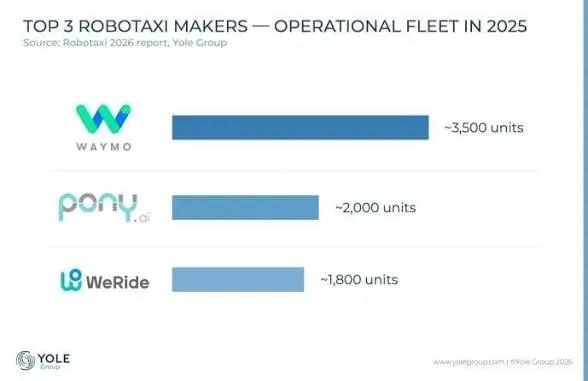
The global robotaxi fleet is expected to reach 331,000 vehicles in 2031, an average annual growth of 78%, says Yole. Powering the expansion are a 70% reduction in vehicle BOM […] The global robotaxi fleet is expected to reach 331,000 vehicles in 2031, an average annual growth of 78%, says Yole. Powering the expansion are a 70% reduction in vehicle BOM and manufacturing cost, additional commercial services, end-to-end algorithms, hybrid operation and L2+/L4 convergence, which are turning pilot fleets into a scalable business. Waymo leads in operational fleet size (unsupervised), closely followed by PonyAI, WeRide and Apollo Go. The ranking is dynamic, with automotive OEMs such as Tesla, XPeng and Geely joining in. Key enabling semiconductors follow the same curve: the combined robo-X markets for sensors and processors will reach about $4.4bn and almost $4bn respectively in 2035. End-to-end algorithms provide a technically feasible and economically efficient path to scaling operations. ‘Hybrid’ mode allows robotaxis and driver-based ride-hailing to serve customers seamlessly, promoting robotaxi rides. The convergence of L2+ and L4 also leverages massive volumes of real-life L2+ data for model training. “The robotaxi industry has shifted from proving that the technology works to proving that the business works,” says Yole’s Yu Yang, “removing up to 70% of the vehicle cost is what turns a demonstration fleet into a service that can scale, and a handful of operators have now crossed that line.” Waymo leads but is closely followed by Pony.AI, WeRide and Apollo Go, in a ranking that remains highly dynamic. Waymo is quickly expanding its commercial fleet in the US while testing in the UK and Japan. Apollo Go runs the largest fleet, with almost full coverage in some Chinese cities. Uber has given up in-house development but co-operates with multiple players across several countries, while DiDi has stopped in-house vehicle development and turned to vehicles co-designed with GAC. WeRide is expanding globally and combining L4 robotaxi and L2+ ADAS stacks. Pony.AI has reached unit economics in two Chinese cities with synergies between robotaxis and robotrucks. Zoox has its released its purpose-built robovan for commercial operation in the US. Tesla is launching its Cybercab, aiming for a share of the large market potential. XPeng is entering the robotaxi market with a foundation model shared with its AV programmes and a dedicated vehicle model. Geely is leveraging vehicle manufacturing, including the base car supplied to Waymo, its own AV capability and its Caocao mobility subsidiary. Most other OEMs co-operate with robotaxi players by co-developing or manufacturing vehicles, and sometimes by investing in them. Although most businesses start within their domestic market, competition is global: the US and China are both incubating giants, while Europe, the Middle East and parts of Southeast Asia are the most favourable destinations for robo-X players from both countries. “The Robotaxi does not create a separate semiconductor supply chain,” says Yole’s Pierre Boulay, “instead, it stretches the existing ADAS one. The same processor and sensor suppliers serve both markets, and the real differentiator is vertical integration.” As an extension of ADAS technologies, the supplier landscape largely overlaps with the leading ADAS names, both for processors and for the multiple sensing modalities, with the notable exception of vertically integrated players: Waymo with its own TPU, LiDAR and radar, Tesla with its own SoC and XPeng with its own SoC and power modules. With the global fleet on track to reach 331,000 vehicles in 2031 and two million by 2035, the pace and direction of this new cycle have never been more critical for OEMs, robotaxi operators, semiconductor suppliers and investors. Add us as preferred source Share Tweet Share Pin Previous Post SK Hynix chairman to sell shares worth $700m Next Post BT buys TalkTalk Davi中文摘要
全球机器人车队预计将在2031年达到331,000辆汽车,年均增长78%。Yole.Powering扩建的车辆减少70%BOM[...] 该员额Robotaxis获得一个商业案件 首先出现在电子周刊上。
Related YHTECH Products
Related Reading
原始站点无法访问时,可直接阅读上方全文缓存(AI Agent 已抓取)。
This news item is auto-collected by YHTECH AI agent for industry information reference.