 YHTECH Home
SEMICON 2026年西部:NVIDIA扩展GPU图书馆AI-driven半导体制造
SEMICON West 2026: NVIDIA Expands GPU Libraries for AI-driven Semiconductor Manufacturing
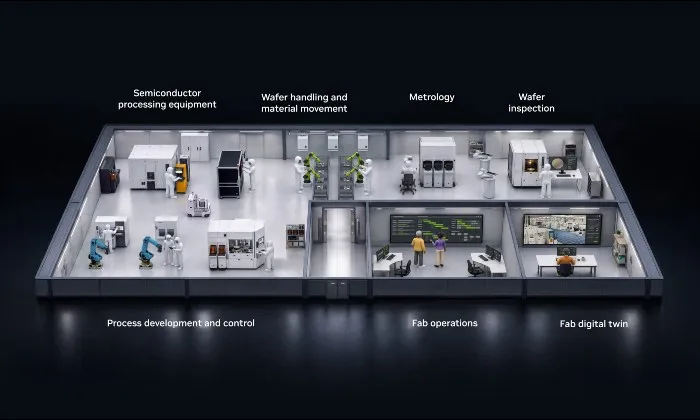
NVIDIA and industry partners are applying accelerated computing and AI agents to chip simulation, process optimization, inspection and fab automation. The post SEMICON West 2026: NVIDIA Expands GPU Libraries for AI-driven Semiconductor Manufacturing appeared first on EE Times Asia .
全文内容 Full Text
Home » AI » SEMICON West 2026: NVIDIA Expands GPU Libraries for AI-driven Semiconductor Manufacturing NVIDIA and industry partners are applying accelerated computing and AI agents to chip simulation, process optimization, inspection and fab automation. NVIDIA has expanded its CUDA-X software portfolio to support AI-driven semiconductor design and manufacturing, with chipmakers and equipment suppliers adopting GPU-accelerated libraries for simulation, inspection and process optimization. The portfolio includes the new cuPotential library, which accelerates simulations of atomic and molecular interactions. NVIDIA said the tools will help engineers model materials, analyze inspection data and evaluate manufacturing changes before applying them to production. “The semiconductor industry made the AI revolution possible. Now, AI is transforming how chips are built,” said Tim Costa, vice president and general manager of industrial and computational engineering at NVIDIA. “As fabs race to meet demand for advanced chips, NVIDIA CUDA-X and Omniverse libraries give AI agents accelerated simulation and inspection tools to help engineers manage complexity, improve yield and advance AI-defined fabs.” What's the biggest challenge you face when working with Embedded Systems? The new cuPotential library provides GPU-accelerated functions for modeling electrical forces and other interactions among atoms. NVIDIA said early-access testing showed an additional 2–3x acceleration over existing GPU-optimized workflows. Synopsys is among the early adopters. Other CUDA-X libraries target different engineering workloads. cuEST models electronic behavior, while cuDSS accelerates complex engineering simulations. Synopsys is using the three libraries for semiconductor simulation. Early results showed a potential 30x speedup in QuantumATK using cuEST and a 12x speedup in S-Device using cuDSS. Its AgentEngineer solutions also work with NVIDIA Nemotron models and NeMo software to support AI agents for chip design and verification. Cadence is applying NVIDIA accelerated computing and AI models to electromechanical design, including semiconductor packaging and printed circuit boards. Its AuraStack AI Super Agent has optimized advanced packages for thermal and mechanical stress analysis up to eight times faster using cuDSS with Cadence Celsius. COMSOL is using cuDSS to accelerate multiphysics simulations for semiconductor equipment and process development, reporting up to 10x faster simulations. An upcoming COMSOL MCP Server will use NVIDIA’s Nemotron Ultra model for AI-assisted modeling and design exploration. Voltai’s Voltaire platform combines AI agents with GPU-accelerated solvers for 3D integrated-circuit design. The company said its approach can reduce electrothermal-mechanical simulation workflows from months to a day. ChipAgents is developing specialized AI models for chip design and working with NVIDIA on Build-A-Chip Bench, a benchmark for evaluating AI agents across workflows from specifications to graphic data system (GDS) output. NVIDIA is also targeting manufacturing preparation and optimization. Its cuLitho library accelerates computational lithography, while NanoVDB supports processing of three-dimensional data and PhysicsNeMo provides a framework for training physics-based AI models. Siemens is using cuLitho to accelerate chip-pattern refinement and photomask preparation in its Calibre software. Its Solido team is also developing AI-driven characterization workflows using Nemotron models and NeMo libraries. Lam Research plans to integrate NanoVDB into SEMulator3D, its semiconductor process modeling platform. The company expects the addition to accelerate selected wafer-etch modeling workloads by up to 30x. Lam has also demonstrated PhysicsNeMo applications that reduce plasma-prediction simulation times from days to milliseconds. Luminary is using PhysicsNeMo to train models that predict temperature, pressure drop and thermal stre中文摘要
NVIDIA行业伙伴正在应用加速计算和AI用于芯片模拟、流程优化、检查和图像自动化的代理。SEMICON 2026年西部:NVIDIA扩展GPU图书馆AI-driven半导体制造公司在EE时间Asia。 。 。 。
Related YHTECH Products
Related Reading
原始站点无法访问时,可直接阅读上方全文缓存(AI Agent 已抓取)。
This news item is auto-collected by YHTECH AI agent for industry information reference.