 YHTECH Home
替换 48 MLCCs有4个LKZ Capacitors为契约,Cost-Effective机器人联合汽车Controllers
Replacing 48 MLCCs with 4 LKZ Capacitors for Compact, Cost-Effective Robot Joint Motor Controllers
1. Robot Joint Miniaturization Puts Greater Design Pressure on DC-Link Capacitors High-performance robots, including quadruped robots, are increasingly moving toward higher integration, lower weight, and... The post Replacing 48 MLCCs with 4 LKZ Capacitors for Compact, Cost-Effective Robot Joint Motor Controllers appeared first on Power Electronics News .
全文内容 Full Text
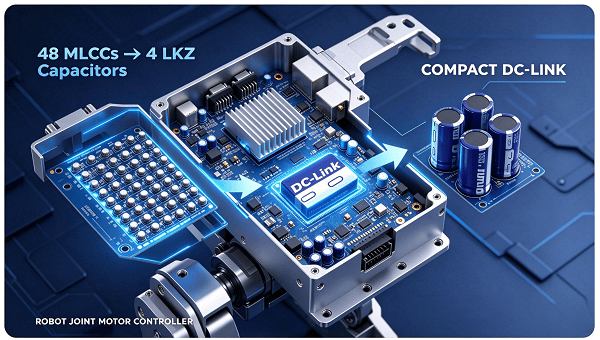
High-performance robots, including quadruped robots, are increasingly moving toward higher integration, lower weight, and more compact mechanical designs. As a result, the space available for power components inside robot joint motor controllers is becoming increasingly constrained. In a joint drive system, the DC-Link capacitor is positioned at the input of the drive bus, close to the power MOSFET bridge. Its primary functions are to absorb DC-bus voltage ripple and provide support for transient high-current demands during motor acceleration and deceleration. Its performance can therefore directly affect power stability and the accuracy of motor-control operation. For DC-Link capacitor design in robot joint motor controllers, several requirements must be addressed simultaneously: sufficient capacitance, high ripple-current capability, limited PCB space, and overall bill-of-materials (BOM) cost. In an actual quadruped robot joint motor project, a conventional solution using multiple MLCCs in parallel had become increasingly difficult to meet all of these requirements at the same time. The customer’s original design used 48 × 100 V, 10 μF MLCCs in a 1210 package, connected in parallel. Using a large number of parallel ceramic capacitors consumed a significant amount of PCB real estate, making it more difficult to further reduce the size of the drive unit for a compact robot joint module. At the same time, the high component count increased the overall bill-of-materials (BOM) cost. Another limitation was the capacitance available from each individual MLCC. The overall solution struggled to handle high-current load conditions. During actual operation, the capacitors exhibited noticeable thermal buildup, accompanied by increased operating noise. As power stability and dynamic response were affected, the motor-control system also failed to achieve the required level of control accuracy expected by the project. For robot manufacturers, however, the resulting cost goes beyond the purchase price of the capacitors themselves. When a large number of components consume valuable PCB space, designing a more compact joint structure becomes more challenging. Insufficient high-current capability can lead to increased heat generation and noise, which may further affect overall robot performance. And when the dynamic response of the power supply begins to affect control accuracy, DC-Link capacitor selection becomes an integral part of the system-level performance. To address the requirements described above, YMIN replaced the original MLCC configuration with its LKZ series liquid aluminum electrolytic capacitors. The LKZ series uses high-density materials and advanced vibration-resistant construction to provide high capacitance in a compact package. For the 100 V, 150 μF LKZ specification used in this project: The actual solution uses four 100 V, 150 μF LKZ capacitors in parallel , each measuring 8 × 25 mm. Compared with the original configuration of 48 × 100 V, 10 μF MLCCs, the LKZ solution significantly reduces the number of components required to provide the DC-Link energy-storage function by increasing the capacitance available from each individual capacitor. This change in architecture addresses capacitance, PCB layout, and component count simultaneously, providing a simpler and more compact implementation for robot joint designs. In this project, the original configuration of 48 × 100 V, 10 μF MLCCs was replaced with four 100 V, 150 μF LKZ capacitors in an 8 × 25 mm package . For the customer, the approximately 20% reduction in occupied space and more than 60% reduction in overall cost delivered direct and quantifiable project value. At the same time, the increased high-current capability—nearly doubling that of the original solution—resolved the previous issues of excessive heat generation and operating noise, while enabling the motor-control system to achieve the required control accuracy. With a single capacitor confi中文摘要
1. 机器人联合Miniaturization打开更大的设计压力DC-Link Capacitors High-performance机器人,包括四重机器人,正日益走向更高的集成度,更低的重量,以及...MLCCs有4个LKZ Capacitors为契约,Cost-Effective机器人联合汽车Controllers最初出现在"电力电子新闻"上.
Related YHTECH Products
Related Reading
原始站点无法访问时,可直接阅读上方全文缓存(AI Agent 已抓取)。
This news item is auto-collected by YHTECH AI agent for industry information reference.