 YHTECH Home
边缘AI MCU特征Multimodal Compute, (Chinese (Simplified) ).Tiered内存
Edge AI MCU Features Multimodal Compute, Tiered Memory
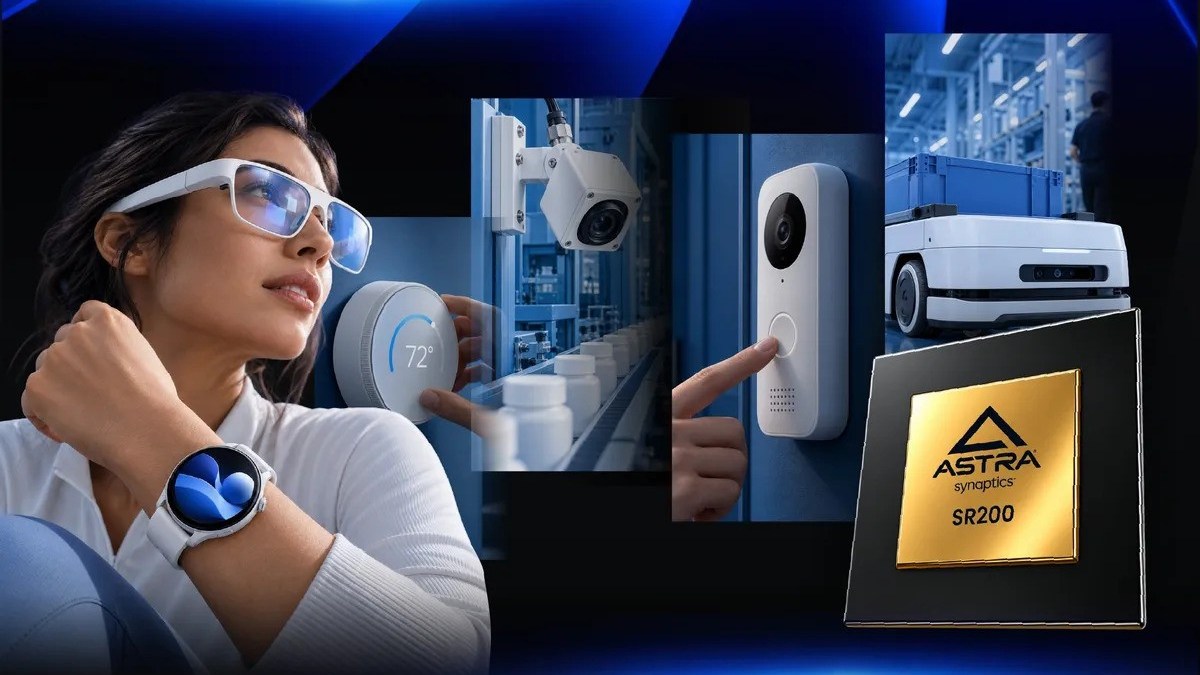
A new MCU combines AI-native acceleration with integrated high-bandwidth DRAM scalable to hundreds of megabytes. The post Edge AI MCU Features Multimodal Compute, Tiered Memory appeared first on EE Times .
全文内容 Full Text
Microcontrollers, going through nonstop evolution, have reached their next inflection point: edge AI. A new MCU takes cloud-based models and brings them into the traditional MCU landscape to make sense of edge AI. Unlike conventional MCUs constrained by limited on-chip memory and compute, Synaptics said its Astra SR200 Series MCUs combine heterogeneous, AI-native compute and acceleration with integrated high-bandwidth custom DRAM scalable to hundreds of megabytes. This enables larger AI models and richer multimodal workloads to run entirely on the device. At Synaptics Tech Day held in San Jose on Oct. 20, 2026, CEO Rahul Patel called SR200 an xMCU because it offers multiple compute dimensions on a single piece of silicon. He also called Synaptics a processor company at the edge. John Weil, VP and GM for IoT and Edge AI Processor Business at Synaptics, called SR200 a new class of microcontrollers. He pointed to three fundamental tenets that enable this design transition. “Synaptics went down this path to enable edge AI-capable devices with always-on low-power modes and a greater compute envelope found in entry-level microprocessor units,” he said. SR200, the industry’s first pairing of the Arm Cortex-M85 and the Cortex-M52 cores, combines high-performance compute with up to 400 GOPS of AI acceleration, 256 MB of custom DRAM, vision and audio capabilities, and hardware-rooted security. The edge AI MCU incorporates Synaptics’s Torq NPU and Google Research’s Coral NPU to power CNN and transformer workloads. Synaptics brings a variety of Arm cores from an ultra-low-power domain to a high-performance domain,” Weil said. “This allows engineers to pick exactly the compute level they want.” That, along with SR200’s tiered memory architecture, is crucial for combining modalities such as voice, vision, audio, motion and contextual sensing, and responding to them in real time. “We have put a lot of time and effort into bringing high-performance and efficient compute to a low price point and low power point,” Weil said. “But we also invested heavily in memory architectures that were designed to feed CPUs and NPUs more efficiently.” Memory architectures are traditionally designed to feed the CPUs and NPUs. However, a closer look at many AI applications shows they typically aren’t even pushing the compute element; instead, they are pushing the memory interface hard. This is why the amount of memory that’s being procured and put into the cloud infrastructure is huge. In a traditional microcontroller, we used to have hundreds of kilobytes of memory. Then it became common to have megabytes of memory. And now we are referring to things in hundreds of megabytes of memory. SR200’s tiered memory architecture builds high-performance compute around an on-chip memory architecture. It also includes a custom DRAM interface with in-package memory, bringing HBM-like high-performance memory to a microcontroller. This tiered memory architecture solves two problems. First, it feeds compute cores efficiently. Second, this appropriate amount of memory supports ultra-low-power, always-on AI processing. The memory is custom-designed to handle processing for applications such as always-on listening and respond to them simultaneously. “In this memory-constrained world that we live in right now, it offers design engineers the potential to build really differentiated edge AI devices,” Weil said. “No one else is talking about MCUs having this level of tiered memory architecture and going into the hundreds of megabytes of capacity.” The SR200 microcontrollers blend high-performance compute with low-power consumption. That’s critical for developing battery-powered edge devices. The tiered memory architecture also plays a key role in enabling ultra-low-power operation. Moreover, if you feed the neural processors more efficiently, you can also reduce the power consumption of the device, Weil added. The SR200 microcontrollers are available in three pin-compat中文摘要
一个新的MCU组合AI-native以集成高频段加速DRAM缩放到上百兆字节。 后边缘AI MCU特征Multimodal Compute, (Chinese (Simplified) ).Tiered内存首先出现于EE时间
Related YHTECH Products
Related Reading
原始站点无法访问时,可直接阅读上方全文缓存(AI Agent 已抓取)。
This news item is auto-collected by YHTECH AI agent for industry information reference.