 YHTECH Home
六个AGIBOT G2 24小时完成1 730项任务Shanghai便利储存审判
Six AGIBOT G2 Robots Complete 1,730 Tasks in 24-Hour Shanghai Convenience Store Trial
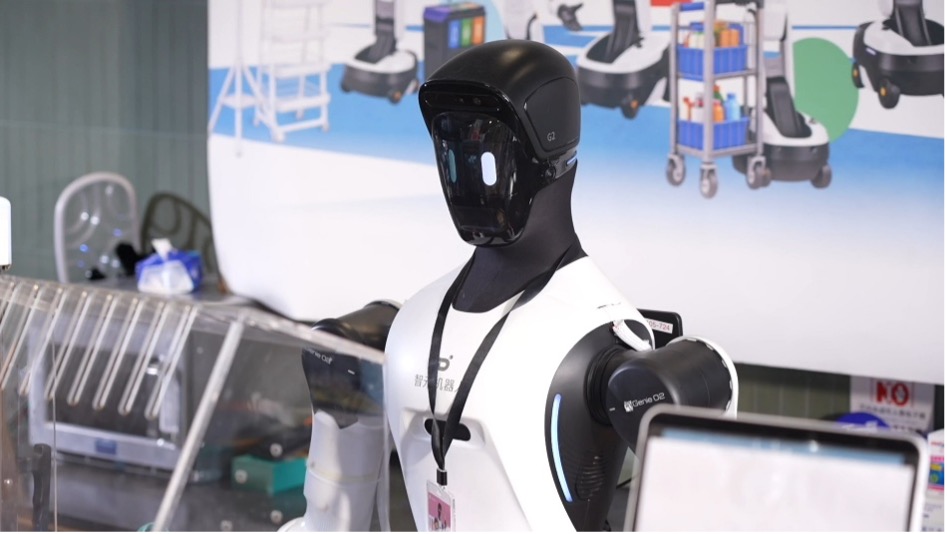
Four of the six robots pass a performance assessment as the trial puts customer service, retail operations and embodied AI capabilities to the test in a working store. The post Six AGIBOT G2 Robots Complete 1,730 Tasks in 24-Hour Shanghai Convenience Store Trial appeared first on The Robot Report .
全文内容 Full Text
Four of the six robots pass a performance assessment as the trial puts customer service, retail operations and embodied AI capabilities to the test in a working store. Six AGIBOT G2 wheeled humanoid robots completed a 24-hour trial at an operating convenience store in Shanghai’s Xuhui District, performing a combined 1,730 tasks ranging from customer assistance and coffee preparation to shelf restocking and cleaning. The trial ran from 10 a.m. on November 2 to 10 a.m. on November 3 and was livestreamed to an audience of more than two million viewers across online platforms. Four of the six robots passed the final performance assessment. The event marked the conclusion of AGIBOT’s AI WAVE technology showcase, launched on October 22. Following a series of releases spanning robotics data, simulation, AI models, hardware and operational software, the convenience store trial brought these technologies together in a real-world setting to examine how robots perform everyday tasks over an extended operating period. More broadly, the trial showed how embodied AI could move beyond controlled demonstrations and operate in the changing conditions of a live, customer-facing environment. The six G2 robots were assigned different responsibilities: customer assistance, shelf inspections, restocking, coffee preparation, checkout and hot food service, and store cleaning. Over the 24-hour period, they completed 683 customer-service interactions, 369 product pickups and deliveries, 147 coffee orders, 126 breakfast servings, 277 shelf inspections and restocking tasks, and 128 table-cleaning tasks. The trial covered four operating periods: the lunchtime rush, evening peak hours, overnight operations and the following morning’s breakfast rush. Each period brought different demands, from handling customer requests during busy hours to maintaining store operations overnight. The robots were assessed on their time on duty, task completion, customer feedback, response times and ability to handle unexpected situations. Four passed the final assessment, while two did not meet all the criteria. Two evaluators also conducted rounds of practical tests based on situations robots might encounter while serving customers. In one test, they ordered regular and sugar-free Coca-Cola to check whether the robots could distinguish between similar-looking products. In another, they rearranged packs of chewing gum on a shelf and asked the robots to return them to their correct positions. The evaluators also blocked an aisle with a person and a box to test whether the robots could identify obstacles and navigate around them. A convenience store may appear to be a relatively straightforward environment for robots. Its layout is compact and many tasks follow standard procedures. Yet everyday activities such as picking up products, restocking shelves and preparing food require robots to adapt to small but frequent changes. A bag of candy hanging at a slightly different angle can be difficult to grasp without disturbing nearby products. Handling a delicate item, such as a slice of cake, requires careful control of gripping force to avoid dropping or damaging it. Unlike a controlled laboratory, an operating store presents constantly changing conditions. Customers move through the aisles, products are picked up and returned, and items vary in position, orientation and packaging. Even when a robot repeats the same task, the conditions may differ from one attempt to the next. During the trial, the G2 robots demonstrated several capabilities designed to address these challenges. They used real-time visual information to identify misplaced merchandise and return it to designated shelf positions rather than relying solely on preset coordinates. A robot assigned to restocking detected gaps on shelves and replenished products without a specific prompt. In the cleaning area, another robot distinguished spills from countertop patterns and selected appropriate tools for cle中文摘要
6个机器人中有4个通过了性能评估 测试将客户服务,零售业务和体现AI在工作室测试的能力。AGIBOT G2 24小时完成1 730项任务Shanghai在《机器人报告》上首次出现
Related YHTECH Products
Related Reading
原始站点无法访问时,可直接阅读上方全文缓存(AI Agent 已抓取)。
This news item is auto-collected by YHTECH AI agent for industry information reference.