 YHTECH Home
OpenAI's Altman 2027年取笑人造人演示
OpenAI's Altman teases humanoid demo in 2027
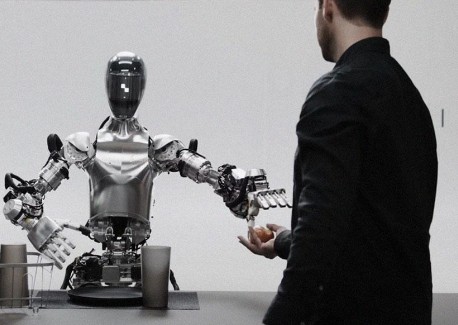
The company is moving from robot hand dexterity to how the humanoid brain relies on AI models
全文内容 Full Text
Oct 19, 2026 11:15am Sensors Applications Motion / Proximity / Position Specialized Domains OpenAI --> OpenAI has researched robot hand dexterity and is now more focused on the humanoid brain with its reliance on AI models. This work puts sensors in focus. (OpenAI) OpenAI CEO Sam Altman recently teased his company will have a ”cool demo in 2027” of a humanoid robot, according to reports. The interesting revelations he made are how the humanoid brain will rely on AI models for its actions, which could pose the most difficult challenge to engineers. That concern compares to another tough job developing humanoid hands and fingers, with all the sensors, actuators and motors needed for moving every joint to lift heavy objects while also screwing on bottle tops. OpenAI has been involved in that work also. But that humanoid brain: think about it. As Altman said, the robot’s designs and details are “less important than really figuring out…the brain that makes the robot work.” OpenAI has a humanoid robotics lab and is hiring nearly 30 robotics engineers, mainly around motion control and whole-robot behavior. His comment does not mean that sensors are unimportant. It means the opposite. The input to the brain still comes from sensing. In its job opening descriptions, the company focuses on motion control, state estimation, actuator control, whole-robot behavior, machine-learning infrastructure for physical AI and work on custom electromechanical actuators. State estimation is important. The humanoid needs to know things like: What is around me? Where is my body exactly as compared to the world, the walls of the room I’m in? What am I touching? How much force do I need to lift a spoon or drill a screw into a metal plate? These are sensors fusion problems, as well as AI model problems. From my research, it doesn’t appear OpenAI has disclosed the sensor suite for its planned humanoid, but from an engineer’s standpoint, the company needs sensors for perception of things like: What’s around it? Where are those things? Where are my arms and hands in relation to other things (proprioception)? How is my body moving (balance and motion)? Did I actually grab the object? Am I holding it securely enough without crushing it? As you think about it, the smarter the humanoid brain becomes, the more it depends on high quality information from the physical world. As ADI’s Paul Golding recently told me: “Intelligence is a property of the system and not of the model.” Related : At the center of physical intelligence and the robot hand The real test for OpenAI is whether it can demonstrate its AI transfers from understanding language and images to understanding a constantly changing physical world. Sensors, therefore, become the robot brain’s connection to reality. Saying that aloud may sound trivial and obvious, but sensors are essential.中文摘要
公司正在从机器人的手性 转向人脑如何依赖AI模型
Related YHTECH Products
Related Reading
原始站点无法访问时,可直接阅读上方全文缓存(AI Agent 已抓取)。
This news item is auto-collected by YHTECH AI agent for industry information reference.