 YHTECH Home
嵌入式传感器是如何使智能浴室现代化的
How embedded sensors are modernizing smart bathroom
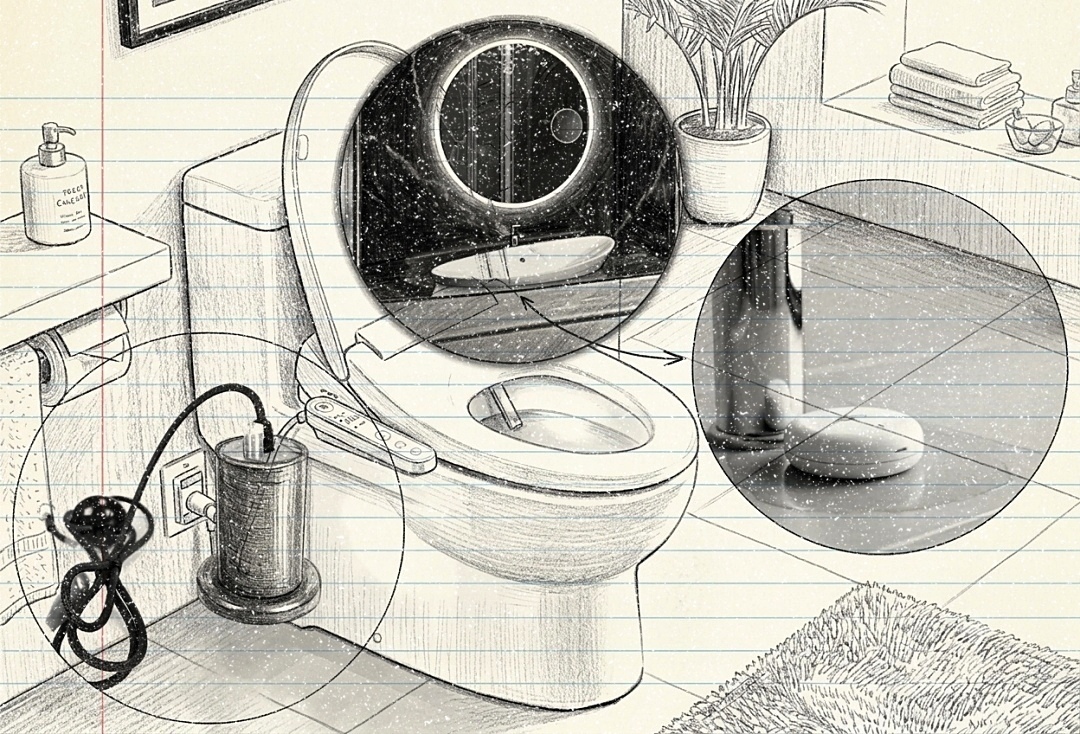
Each embedded sensing technology contributes to a holistic ecosystem where hygiene, resource management, and wellness converge. The post How embedded sensors are modernizing smart bathroom appeared first on EDN .
全文内容 Full Text
The humble bathroom is undergoing a quiet, high‑tech revolution. Far beyond simple automated faucets, today’s residential and commercial restrooms are dense mesh networks of solid‑state transducers, optical detectors, and environmental sensors. In this installment of Fun with Fundamentals , we take a look under the hood at the core sensor technologies driving sanitation, water conservation, structural protection, and preventive health tracking. Touchless faucets, soap dispensers, and automatic flushers rely on infrared proximity systems that use LEDs pulsing at wavelengths around 850–940 nm and photodiodes to detect reflected intensity. Premium designs now employ time‑of‑flight VCSEL sensors, which measure the precise transit time from photon emission to reflection. By eliminating false triggers caused by skin tone variations, dark clothing, or reflective chrome sinks, these sensors deliver consistent activation across diverse restroom environments, ensuring reliable hygiene automation. Figure 1 The TMF8805 optical dToF module package features an integrated vertical-cavity surface-emitting laser (VCSEL). Source: ams-OSRAM Direct time-of-flight (dToF) emits short light pulses and uses a precise digital timer (such as a SPAD detector) to directly measure the time photons take to travel to an object and bounce back. In contrast, indirect time-of-flight (iToF) emits a continuous, modulated light wave and calculates distance indirectly by measuring the phase shift of the reflected signal. Consequently, dToF is the preferred choice for long-range, outdoor applications seeking low power consumption. Meanwhile, iToF excels at short-range indoor tasks requiring high spatial resolution, such as close-up 3D face mapping. Smart toilet lids and ambient presence lighting are enabled by radar systems that exploit Doppler shift and frequency‑modulated continuous wave principles. Complementing these are high‑precision NTC thermistors that measure shower feed temperatures continuously, with microcontrollers actuating motorized mixing valves in real time to lock temperatures within ±0.5 °C and eliminate thermal shock. Meanwhile, Hall‑effect magnetic flow meters or ultrasonic time‑delay flow meters track volumetric flow rates, logging usage metrics and assisting in household water management. As a quick aside, standard ultrasonic flow meters serve as an umbrella category for non-invasive velocity sensors, encompassing both Doppler-shift and time-of-flight operating principles. By contrast, an ultrasonic time-delay flow meter specifically employs the transit-time (time-of-flight) method, calculating liquid velocity by measuring the nanosecond differential between acoustic pulses traveling upstream versus downstream. While Doppler variants depend on suspended solids or bubbles to reflect sound frequencies, time-delay meters require clean, acoustically clear fluids to derive precise volumetric flow rates from signal propagation times. Figure 2 This is a DIY kit of a handsfree motion sensor toilet flusher that automates flushing to promote touchless hygiene and reduce germ spread. Source: Amazon.com Smart exhaust fans, air purifiers, and defogging mirrors depend on humidity sensors that use a hygroscopic polymer dielectric between electrodes, where moisture absorption changes capacitance proportionally to relative humidity. Metal‑oxide semiconductor gas sensors add another layer of protection by heating a tin‑dioxide element, where reduction reactions with airborne volatile organic compounds (VOCs) alter conductivity. Together, these detectors trigger adaptive fan speed ramps, controlling mold risks, odors, and condensation while maintaining a healthier bathroom environment. Heated toilet seats and automated bidet systems incorporate capacitive touch foils that sense the dielectric permittivity of the human body when seated, while piezoresistive strain gauges confirm mechanical weight through Wheatstone bridge deformation. This dual‑valid中文摘要
每一种嵌入式感知技术都有助于形成一个整体生态系统,使卫生、资源管理和健康相互融合。EDN。 。 。 。
Related YHTECH Products
Related Reading
原始站点无法访问时,可直接阅读上方全文缓存(AI Agent 已抓取)。
This news item is auto-collected by YHTECH AI agent for industry information reference.