 YHTECH Home
NSING特性CRA, (Chinese (Simplified) ).AI电子机器人、汽车控制和数字能源a
NSING Featured CRA, AI Robotics, Motor Control and Digital Energy at electronica 2026
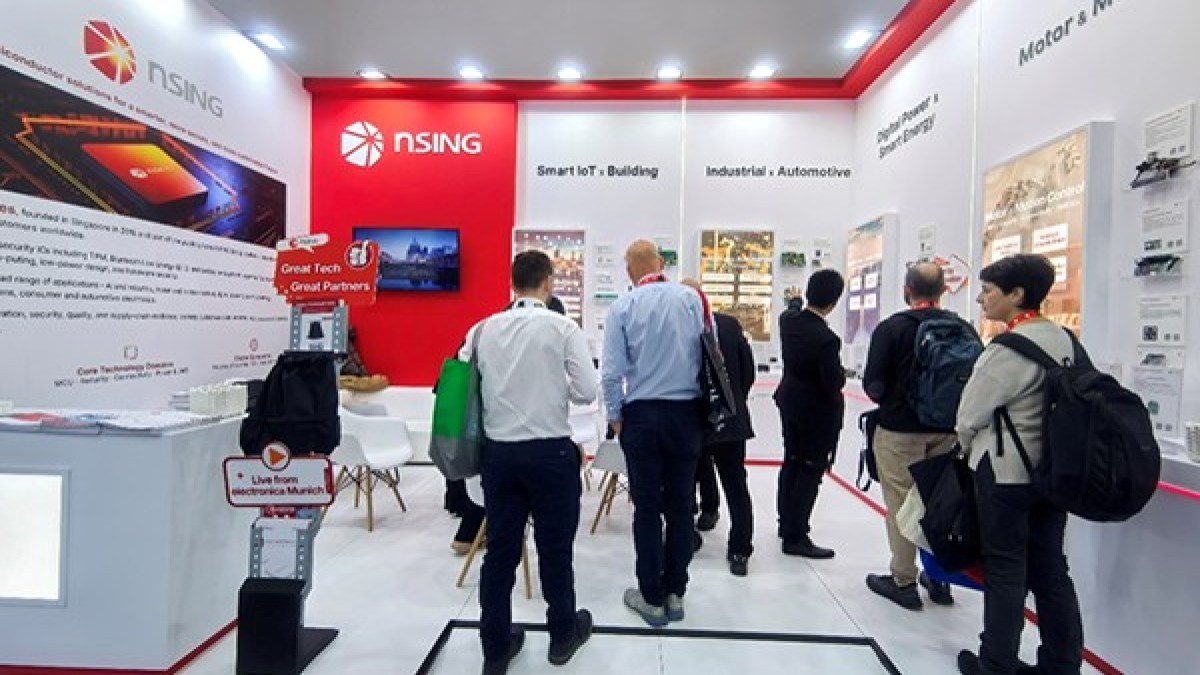
At electronica 2026 in Munich, NSING exhibited 35 solutions built on N32‑series MCUs, N32WB BLE SoCs and NS350 TPM, covering AI robotics, motor control and digital energy, and presented its CRA compliance offerings. The post NSING Featured CRA, AI Robotics, Motor Control and Digital Energy at electronica 2026 appeared first on EE Times .
全文内容 Full Text
The Singapore-based MCU and security-IC supplier showed 35 applications and solutions in Munich and argued that European buying decisions now turn on three things: evidence a chip can survive a Cyber Resilience Act audit, real-time response in AI robotics, and efficient power conversion for digital energy. NSING Technologies, the Singapore-based fabless semiconductor arm of NSING Group (300077.SZ; 02701.HK), has concluded its participation in electronica 2026, which closed on 13 November at Messe München, after displaying 35 applications and reference designs on its Hall C2 stand (Booth 741), grouped around the questions European OEMs brought to the show: how to prove a product is cyber-secure before the EU Cyber Resilience Act becomes fully binding in December 2027, how to make a robot joint respond in real time, and how to convert power efficiently in digital-energy systems. The show’s official themes — artificial intelligence, network resilience and energy efficiency — ran through the booth. What tied them together, according to the company, was a shift in where the difficulty now sits: less in any single chip’s peak specification, more in the compliance file, at the joint and in the power stage. A sizeable share of the booth went to the EU Cyber Resilience Act (Regulation (EU) 2024/2847), which is less about features than about evidence. The regulation entered into force on 10 December 2024. Reporting obligations for actively exploited vulnerabilities and severe incidents took effect on 11 September 2026. The main obligations — conformity assessment and CE marking — apply from 11 December 2027. For procurement teams, that sequence mattered more than the headline date. The reporting duty is already enforceable, and the design changes plus documentation needed to pass assessment have roughly a year to land. “Future compliance” is no longer an accurate description of the situation. NSING maps its portfolio onto the regulation’s classes. N32S security ICs and TPM devices at CC EAL4+ support third-party assessment for Critical-class products. Cortex-M4 and Cortex-M7 MCUs, including the N32H and N32G4 families, are positioned for Class 2, with chip-level SESIP certification in progress. Cortex-M0 parts such as the N32G0 and N32WB fit the Class 1 self-declaration route. Beyond the silicon, the company packages what an OEM has to put in the file: an ECR (essential cybersecurity requirements) mapping table, a software bill of materials, a compliance support pack and introductions to notified bodies. These are organised around a five-step route — classification and threat modelling, secure development practice, validation and bill-of-materials control, system documentation with a vulnerability reporting channel, and assessment plus CE archiving. Post-quantum migration sits on the same axis. NSING’s MCUs integrate ML-KEM (512/768/1024) and ML-DSA (44/65/87), starting with the N32H4xx and N32H7xx and extending across its Cortex-M4-and-above N32 line, covering key establishment, device identity, firmware update and secure boot, and data integrity checks. The implementations coexist with RSA, ECC, SHA, and ship with drivers, a crypto abstraction layer, example code and a porting guide — the building blocks for an assessment, hybrid-verify, migrate and evolve sequence. On the power-conversion side, the pitch is topology coverage rather than a single headline number. The N32DP474 runs PFC, LLC resonant conversion and multiphase interleaved topologies from one device; NSING characterises peak efficiency at up to 99% under rated load, and says a reference design built on it is already in volume production with server-power customers. For energy storage, the NB1802 analog front end monitors 18 series-connected cells, covering 1500 V container systems and residential packs. The bottleneck in humanoid robots is not the model. It is the joint — torque, speed and position loops that have to close deterministically while the rest of the中文摘要
在电子a 2026英寸Munich, (Chinese (Simplified) ).NSING展示35个基于N32 MCUs, (Chinese (Simplified) ).N32WB BLE SoCs和NS350 TPM,覆盖AI机器人、发动机控制和数字能,并介绍其CRA该职位NSING特性CRA, (Chinese (Simplified) ).AI机器人、汽车控制和数字能源在电子a 2026上首次出现EE时间
Related YHTECH Products
Related Reading
原始站点无法访问时,可直接阅读上方全文缓存(AI Agent 已抓取)。
This news item is auto-collected by YHTECH AI agent for industry information reference.