 YHTECH Home
人类手上有多少传感器?XELA第368条。 )
How many sensors in a humanoid hand? (XELA counts 368.)
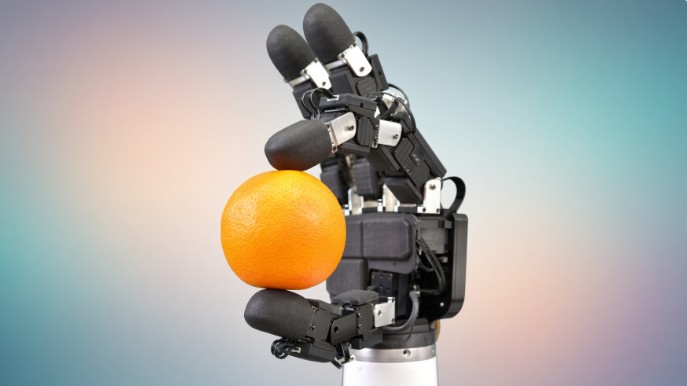
Humanoid hands will need hundreds of sensors for tactile, force and more. One company already counts 368 sensors per hand.
全文内容 Full Text
Oct 23, 2026 3:07pm Sensors Applications Synaptics Infineon Technologies AG Mechanical / Force / Tactile --> XELA counts 368 sensors in this one humanoid hand with 1,472 sensing points. Heard enough? Humanoid hands have become an obsession for building Optimus and many other bots coming to market. (XELA) Everything Elon Musk divulged recently about the complex engineering work at Tesla to create a durable and capable Optimus humanoid hand demonstrates the central role that tactile and force sensors hold in building effective robots in coming years. RELATED: Musk spills on Optimus’ hand, Tesla’s planned Optimus Academy For companies like Boston Dynamics and Tesla and many Chinese companies making humanoids, the hand and fingers must move precisely, of course, but they must also sense how heavy objects are and their position in space. At the more delicate level, the hands and fingers will need to know if what’s being touched is soft and delicate like cloth, or fine like surgical sutures or solid and hard like a metal pipe, dental instrument or doorknob. Some humanoids are being built with grippers instead of fingers that must carry storage bins or heavy metal plates used in making cars, but they will still need sensors to know when the bin or plate is gripped and released, which will likely coordinate with an optical system, probably using the robot’s eyes or cameras elsewhere on the body. How humanoids will be deployed in industrial or consumer applications will make a difference in the type or sensors used, but sensors designers like Synaptics and Infineon are already busy creating the magic. Both companies showed off sensors for robot grippers and humanoid hands in recent days seen by Phil Solis, research director at IDC. Synaptics showed a prototype of a slip detector with a 5 x 12 array of force sensors. A prototype module had a grippy material for both robot grippers and humanoids. “The force sensors only detect how much pressure there is perpendicular to the sensor, but software using the data from the array could use the data to see the force on each sensor and how that force was changing to detect movement parallel to the sensor so it could detect slipping,” Solis explained. “This is useful for more delicate objects so that minimal force can be used or for heavier objects to make sure enough force is being used. I imagine it could be used for more nuanced control of how something is held.” He likened this humanoid sensing to how a human steers a car out of a turn, by letting the steering wheel slide in their hands and adjusting the force of their grip to allow the wheel to turn at just the right speed. Over at Infineon, Solis said he saw 2 x 2 sensors used at the fingertips and the next finger segment, as well as one for thumb. That equals 9 modules per hand and 18 for two hands with four force sensors per module, or 72 sensor modules in all for a single humanoid. “That number might be plenty for some applications, but in the future we will likely see many more modules with a finer resolution of force sensors. “Hands will have hundreds of force sensors in the most capable design,” Solis predicted. XELA Robotics already makes one robotic hand model with 368 sensing points, with four measurements per sensor, or 1,472 sensing points. (See below.) Synaptics showed a tactile data collection glove with 600 sensing point per glove with 7 tactile regions powered by the Synaptics SN6012T, a touch and capacitive sensing controller for use in robotics and physical AI applications. Synaptics tactile data collection glove (Phil Solis) Solis talked about force sensors, which are a subset of a tactile-sensing system. There are different types of force sensors but they all generally change electrical properties when force is applied, Solis said. Strictly speaking, a force sensor measures how much force is applied. A simple force sensor might give one value: the fingertip is pressing with X amount of force. By comparison, a t中文摘要
Humanoid一个连已经计算出每只手有368个传感器。
Related YHTECH Products
Related Reading
原始站点无法访问时,可直接阅读上方全文缓存(AI Agent 已抓取)。
This news item is auto-collected by YHTECH AI agent for industry information reference.