 YHTECH Home
如何研究Japanese印刷电路板市场:销售和采购5个关键信息点
How to Research the Japanese Printed Circuit Board Market: 5 Key Information Points for Sales and Procurement
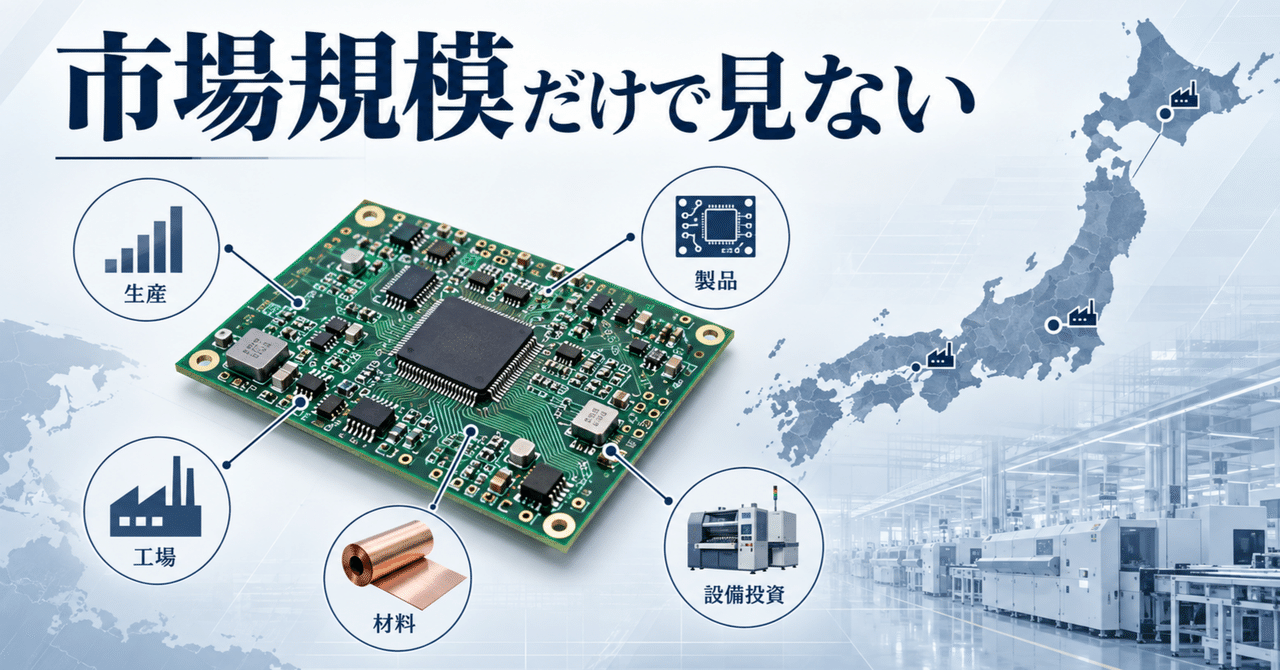
Have you ever tried to research the printed circuit board market and searched for:"How large is the Japanese PCB market?""What is the projected growth percentage?"Have you ever searched for ...
全文内容 Full Text
製造業サプライチェーン研究所 2026年10月10日 16:41 Have you ever tried to research the printed circuit board market and searched for: However, in the practical work of sales and procurement, knowing the market size and growth rate alone does not determine what to do next. For procurement, it is "Which materials or suppliers are at risk?" Only by breaking it down to that level does market information become actionable for practical use. In this article, we will organize five pieces of information that sales and procurement professionals should check when researching the Japanese printed circuit board market. The first thing you want to confirm is what the market data is actually aggregating. "Printed circuit board," "PCB," "electronic circuit board," and "assembled board" are sometimes used interchangeably in articles and research reports, but they are not necessarily the same in statistics. In the Japan Standard Industrial Classification, "electronic circuit board manufacturing" and "electronic circuit assembly manufacturing" are categorized separately. JPCA also aggregates the production value and quantity of electronic circuit boards and electronic circuit assembly boards based on the Ministry of Economy, Trade and Industry's Current Survey of Production. There is a possibility that the target products, regions, or scope of aggregation are different. The first task is to confirm "what is included in these figures." Why is market size alone insufficient for sales and procurement decisions? and semiconductor package substrates all have different customers, materials, and equipment. Even if the overall market is growing, it does not necessarily mean that the fields your company is involved in are growing. According to JPCA, the overseas production value of electronic circuit boards by Japanese manufacturers has exceeded domestic production value since 2013. the market data you see might not reflect the actual production base. Confusing these two will change how you view potential sales leads or suppliers. "breaking the market down into units that your company can evaluate" In manufacturing practice, it is easier to organize information by dividing it into the following five categories: When looking at the market as a whole, check not only the value but also the volume. This is because an increase in value does not necessarily mean an increase in production volume. Production value can increase even if the ratio of high-value-added products rises or if material and processing costs go up. "An increase in value does not necessarily mean the factory has become busier." For management decisions, look at unit prices and product composition. It is easier to judge market changes by looking at both together. For example, even if demand for AI servers grows, it does not necessarily mean an increase in demand for boards used in general industrial equipment. In sales, there are cases where only the company name is looked at. However, in the manufacturing industry, even within the same company, the products being made differ from factory to factory. Looking at the head office location does not reveal actual demand. For companies selling equipment, consumables, materials, jigs, etc., it is increasingly important to look at things on a factory-by-factory basis. You cannot understand supply risks by looking at printed circuit boards alone. Even if a board manufacturer has production capacity, they cannot increase production if they lack materials. "Are those board manufacturers dependent on the same material manufacturer?" Even if you have two suppliers, if the upstream material comes from the same single company, you may effectively still be relying on a single source. In the PCB industry in particular, it is necessary to look not just at simple production capacity, but also at Even if capital investment is increasing, it is possible that investment is concentrated on high-value-added products rather than the general-purpose中文摘要
你曾经尝试过研究印刷电路板市场 并寻找:Japanese PCB“预计增长率是多少?”
Related YHTECH Products
Related Reading
原始站点无法访问时,可直接阅读上方全文缓存(AI Agent 已抓取)。
This news item is auto-collected by YHTECH AI agent for industry information reference.