 YHTECH Home
Reflow奥文或热气枪:最适合你的SMT集会需求?
Reflow Oven or Hot Air Gun: Which Is Best for Your SMT Assembly Needs?
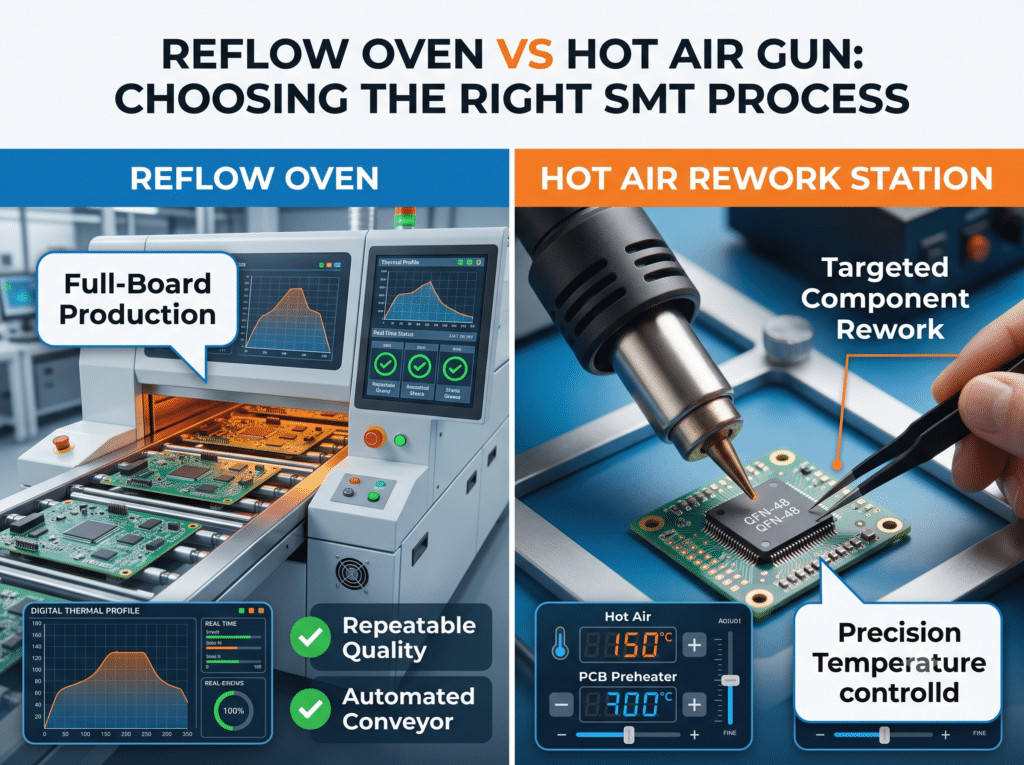
Choosing between a reflow oven and a hot air gun is not simply a question of budget. It is a process decision that affects solder-joint consistency, ...
全文内容 Full Text
Choosing between a reflow oven and a hot air gun is not simply a question of budget. It is a process decision that affects solder-joint consistency, throughput, operator dependence, component safety, and how easily the result can be repeated. For most assembled boards, batches, or production runs, a reflow oven is the better primary process because it heats the entire PCB according to a controlled thermal profile. A hot air gun—or, more accurately for electronics work, a temperature-controlled hot air rework station—is best for localized tasks such as component replacement, prototype correction, and low-volume experimental work. The practical answer is therefore straightforward: choose a reflow oven when you need repeatable full-board soldering, and choose professional hot air when you need flexible, targeted heating. Many SMT operations need both, but they should not be assigned the same job. A reflow oven controls full-board production, while hot air supports precise local rework. Both methods use heated air, but the way they transfer and control heat is fundamentally different. A reflow oven carries the populated PCB through a sequence of heating and cooling zones. Those zones are adjusted to create a thermal profile with preheat, soak, reflow, and controlled cooling stages. The objective is to bring solder paste and component terminations through the required temperature cycle while limiting thermal shock and excessive time above liquidus. A hot air tool directs heat at a small area from above. The operator controls the nozzle position, airflow, temperature setting, distance, angle, and dwell time. That flexibility is useful when one component must be removed or installed, but it also makes the outcome highly dependent on technique. The displayed temperature is not the same as the temperature at the solder joint, and surrounding components can receive very different levels of heat. In other words, an oven manages a board-level process; hot air manages a local intervention. The greatest advantage of a reflow oven is repeatability. Once a suitable recipe is established and verified with thermocouples or a profiling system, boards can move through the same zone temperatures, conveyor speed, and cooling conditions. This reduces variation between operators and shifts. It also gives engineers a process record that can be adjusted when the PCB design, solder paste, component mix, or loading changes. This control matters on boards with a wide range of thermal masses. A large ground plane, shield, connector, fine-pitch IC, and tiny passive component do not heat at the same rate. A multi-zone oven gives the assembly time to approach a balanced temperature before peak reflow, which is difficult to achieve by manually sweeping hot air across the board. Reflow ovens are designed for repeated board flow. They can connect with printers, placement machines, conveyors, inspection systems, and downstream handling equipment. Even a modest production line benefits when the heating stage does not become a manual bottleneck. If your requirement includes recurring batches, multiple product variants, or a path toward higher output, an automatic reflow soldering oven provides a more scalable foundation than processing each board by hand. The initial investment is higher, but labor per board and operator-to-operator variation can be significantly lower once the process is established. A stable reflow process helps reduce defects linked to uneven or poorly timed heating, including incomplete wetting, solder balls, tombstoning, excessive flux residue, and component movement. An oven does not automatically eliminate these defects—stencil design, paste condition, placement accuracy, PCB finish, pad geometry, and component quality still matter—but it makes the heating stage measurable and repeatable. The controlled cooling section is also important. Cooling influences solder-joint formation and keeps the board from remaining hot longer than n中文摘要
选择回流炉和热气枪不仅仅是预算问题,而是影响焊接器-联合一致性的流程决定,......
Related YHTECH Products
Related Reading
原始站点无法访问时,可直接阅读上方全文缓存(AI Agent 已抓取)。
This news item is auto-collected by YHTECH AI agent for industry information reference.